Choosing the right HVAC system size isn’t just a technical detail, it’s one of the most important decisions you’ll make for your home’s comfort, energy efficiency, and long-term costs.
And yet, it’s where many homeowners go wrong.
Too small? Your system will struggle constantly.
Too big? You’ll waste money and sacrifice comfort.
Let’s break it down in a way that actually makes sense, no engineering degree required.
Why HVAC Size Matters More Than You Think
When people hear “HVAC size,” they often think it refers to the physical dimensions of the unit.
It doesn’t.
HVAC size refers to cooling and heating capacity, typically measured in:
The goal is simple:
Your system should match your home’s heating and cooling demands as closely as possible.
When it doesn’t, problems start quickly.
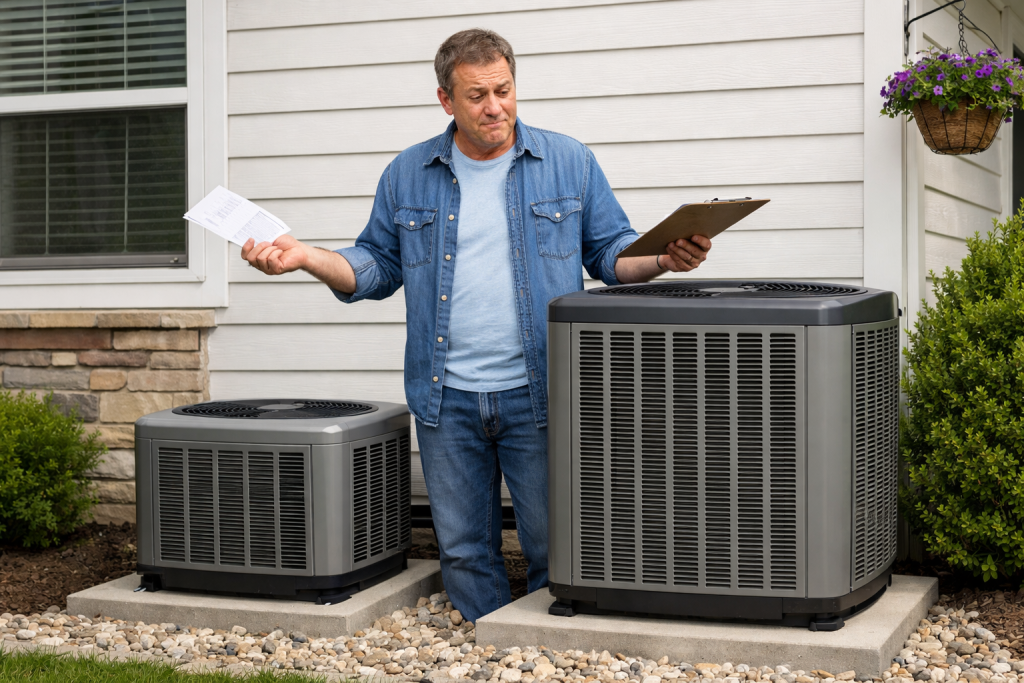
What Happens If Your HVAC System Is Too Small?
An undersized system might seem like a budget-friendly choice, but it comes at a cost.
Common Issues:
- Constant running without reaching desired temperature
- Higher energy bills
- Uneven temperatures throughout the home
- Increased wear and tear
Imagine trying to cool your entire house with a single window unit. That’s essentially what’s happening.
Over time, this leads to premature system failure and ongoing discomfort.
What Happens If Your HVAC System Is Too Large?
Bigger isn’t better when it comes to HVAC.
An oversized system cools your home too quickly, but that’s actually a problem.
Why?
Because it shuts off before completing a full cycle.
This leads to:
- Poor humidity control (your home feels sticky)
- Frequent on/off cycling (called short cycling)
- Higher energy consumption
- Reduced system lifespan
It’s like driving in stop-and-go traffic all day, your system wears out faster.
HVAC Sizing Basics: BTUs, Tons, and Square Footage
Here’s where most guides stop, but we’ll go further.
General Rule of Thumb:
So if your home is:
- 1,500 sq ft → ~30,000 BTUs
- 2,000 sq ft → ~40,000 BTUs
That translates to:
- 2.5 tons (30,000 BTUs)
- 3.5 tons (42,000 BTUs)
But here’s the truth…
Square footage alone is NOT enough.
The Biggest Factors That Affect HVAC Sizing
This is where most homeowners, and even some contractors, get it wrong.
1. Insulation Quality
A well-insulated home retains air better, requiring less capacity.
2. Ceiling Height
Higher ceilings = more air volume = more cooling needed.
3. Window Size and Placement
Large or sun-facing windows increase heat gain.
4. Climate Conditions
Hotter climates require more cooling capacity.
5. Number of Occupants
People generate heat. So, more people = higher load.
6. Ductwork Condition
Leaky ducts can waste up to 30% of airflow.
Why Online HVAC Size Calculators Can Be Misleading
Search “HVAC size calculator,” and you’ll find dozens of tools.
The problem?
They rely on simplified assumptions.
They don’t account for:
- Insulation differences
- Air leakage
- Home layout
- Sun exposure
Using them alone is like guessing your shoe size without trying them on.
The Right Way to Determine Your HVAC Size
Professionals use something called a Manual J Load Calculation.
This is the gold standard in HVAC sizing.
It evaluates:
- Square footage
- Insulation levels
- Windows and doors
- Orientation of your home
- Local climate data
It’s detailed, precise, and essential if you want the right system.
Common HVAC Sizing Mistakes to Avoid
1. Replacing with the Same Size System
Just because your old system was 3 tons doesn’t mean it was correct.
2. Choosing Based on Price Alone
Smaller systems may be cheaper upfront, but cost more long-term.
3. Assuming Bigger Is Better
Oversizing is one of the most common and expensive mistakes.
4. Ignoring Ductwork Issues
Even the perfect system fails with poor duct design.
When to Call a Professional for HVAC Sizing
If you’re:
- Replacing an HVAC system
- Building a new home
- Experiencing uneven temperatures
- Seeing high energy bills
…it’s time to get a professional evaluation.
A properly sized HVAC system will:
- Improve comfort
- Lower energy costs
- Extend equipment lifespan
- Increase home value
How HVAC Size Impacts Indoor Air Quality
Most homeowners think HVAC sizing is only about temperature, but it also directly affects the air you breathe.
An improperly sized system can:
- Fail to filter air effectively
- Circulate dust, allergens, and pollutants
- Create excess humidity that promotes mold growth
An oversized system, in particular, doesn’t run long enough to properly dehumidify your home. That lingering moisture becomes a breeding ground for bacteria and mold spores.
On the other hand, a correctly sized system runs balanced cycles that:
- Improve filtration
- Maintain ideal humidity levels
- Keep air consistently fresh
This is especially important for households with:
In short, HVAC sizing isn’t just about comfort, it’s about health.
The Relationship Between HVAC Size and Energy Efficiency Ratings
You’ve probably seen terms like:
- SEER (Seasonal Energy Efficiency Ratio)
- AFUE (Annual Fuel Utilization Efficiency)
But here’s what most guides don’t tell you:
Even a high-efficiency system performs poorly if it’s the wrong size.
An oversized 20 SEER unit can waste more energy than a properly sized 14 SEER system.
Why?
Because efficiency ratings assume:
- Proper installation
- Correct sizing
- Ideal operating conditions
If your system short cycles or runs constantly due to improper sizing, those efficiency ratings become meaningless.
How Home Age Affects HVAC Sizing
Older homes and newer homes have very different HVAC needs.
Older Homes:
- Poor insulation
- Air leaks
- Drafty windows
Require larger capacity systems
Newer Homes:
- Better insulation
- Energy-efficient windows
- Sealed construction
Require smaller, more efficient systems
This is why simply copying your neighbor’s HVAC size rarely works.
Two homes with the same square footage can need completely different system sizes.
The Hidden Impact of Windows on HVAC Size
Windows are one of the biggest contributors to heat gain and loss.
Key factors include:
- Size
- Type (single vs double-pane)
- Direction (north vs south-facing)
Large, sun-facing windows can significantly increase cooling demand.
For example:
- A home with large west-facing windows may need a larger AC system
- A shaded home may require less capacity
Modern solutions like:
- Low-E glass
- Window films
- Thermal curtains
…can reduce this load and impact your HVAC sizing needs.
HVAC Zoning: A Smarter Alternative to Oversizing
Many homeowners oversize their system to fix uneven temperatures.
But there’s a better solution: HVAC zoning.
Zoning divides your home into separate areas, each with its own temperature control.
Benefits include:
- Targeted comfort
- Reduced energy waste
- Elimination of hot/cold spots
Instead of installing a larger system, zoning allows your HVAC system to work smarter, not harder.
How HVAC Size Affects System Lifespan
Your HVAC system is a long-term investment and sizing plays a major role in how long it lasts.
Undersized System:
- Runs constantly
- Experiences excessive wear
- Breaks down sooner
Oversized System:
- Frequently turns on/off
- Causes mechanical stress
- Shortens lifespan
A properly sized system operates in balanced cycles, reducing strain and maximizing longevity.
This can add years to your system’s life.
The True Cost of Choosing the Wrong HVAC Size
The upfront cost of an HVAC system is only part of the story.
Choosing the wrong size can cost you in multiple ways:
Short-Term Costs:
- Higher installation costs (if oversized)
- Immediate inefficiency
Long-Term Costs:
- Increased energy bills
- Frequent repairs
- Early replacement
Over time, these costs can add up to thousands of dollars.
How Climate Zones Influence HVAC Sizing
Not all regions require the same HVAC capacity.
Hot climates require:
- Higher cooling capacity
- Stronger humidity control
Mild climates require:
- Balanced systems
- Less extreme capacity
This is why professional load calculations include climate data.
Ignoring this factor leads to poor performance and inefficiency.
Signs Your Current HVAC System Is the Wrong Size
Not sure if your system is properly sized?
Here are clear warning signs:
Signs of an Undersized System:
- Runs constantly
- Never reaches set temperature
- Higher-than-normal energy bills
Signs of an Oversized System:
- Turns on/off frequently
- Uneven cooling
- High humidity indoors
If you notice these issues, it’s worth getting a professional evaluation.
Final Thoughts: Size Isn’t Just a Number, It’s a Strategy
Choosing the right HVAC size isn’t about guessing or following a quick chart.
It’s about understanding your home as a system.
When everything aligns, size, airflow, insulation, you get:
- Consistent comfort
- Lower bills
- Peace of mind
And that’s the real goal.