Many homeowners rarely think about their HVAC air filter until something goes wrong. Maybe the air conditioner isn’t cooling as well as it used to, your energy bill suddenly climbs, or dust seems to collect on every surface no matter how often you clean.
In reality, one of the smallest and least expensive parts of your heating and cooling system plays one of the biggest roles in keeping your home comfortable. An HVAC air filter does much more than trap dust, it helps protect your equipment, supports healthy indoor air, maintains proper airflow, and improves overall system efficiency.
For homeowners in Tracy, California, where summers are hot and HVAC systems often run for extended periods, replacing your air filter on time can make a noticeable difference in comfort and operating costs.
This guide explains exactly what an HVAC air filter does, how often you should replace it, how to choose the right filter, and the warning signs that indicate it’s time for a new one.
What Is an HVAC Air Filter?
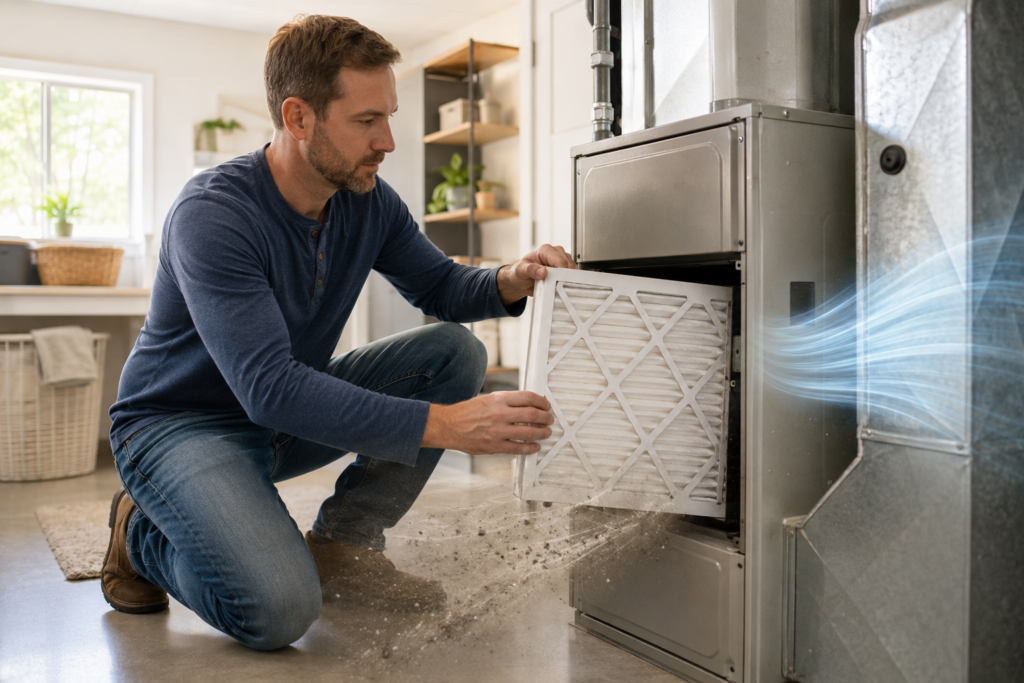
An HVAC air filter is installed inside your heating and cooling system where air returns from your home before passing through the furnace or air conditioner.
As your system circulates air throughout the house, the filter captures airborne particles such as:
- Dust
- Dirt
- Pet hair
- Pet dander
- Pollen
- Mold spores
- Lint
- Fibers
- Certain bacteria
- Other airborne contaminants
Without a filter, these particles would continuously circulate throughout your home while also accumulating inside sensitive HVAC components.
Think of your HVAC air filter as the lungs of your home’s comfort system. Clean airflow allows your equipment to operate efficiently, while restricted airflow forces it to work much harder.
What Does Your HVAC Air Filter Actually Do?
Many people believe an air filter exists only to improve indoor air quality. While that’s certainly important, its primary purpose is actually to protect your HVAC equipment.
Here are the four biggest jobs your air filter performs.
1. Protects Your HVAC Equipment
Dust may seem harmless, but inside an HVAC system it becomes a serious problem.
When dirt reaches internal components like the blower motor, evaporator coil, and heat exchanger, it creates buildup that reduces efficiency and increases wear.
A clean filter helps prevent dirt from reaching these expensive components.
2. Improves Indoor Air Quality
Every day your HVAC system circulates thousands of cubic feet of air through your home.
Without filtration, that same dust, pollen, and pet dander simply keeps recirculating.
Replacing your air filter regularly helps reduce:
- Household dust
- Seasonal allergens
- Pet dander
- Airborne debris
- Certain mold spores
Although standard filters aren’t medical-grade air purifiers, they still contribute to noticeably cleaner indoor air.
3. Maintains Proper Airflow
Your HVAC system is carefully designed to move a specific amount of air.
A clogged filter restricts that airflow.
When airflow decreases, several problems may occur:
- Uneven temperatures
- Weak airflow from vents
- Longer cooling cycles
- Reduced heating performance
- Frozen evaporator coils
- Increased equipment strain
Simply replacing a dirty filter often restores normal airflow.
4. Helps Lower Energy Consumption
When airflow becomes restricted, your HVAC system must run longer to maintain the thermostat setting.
Longer run times mean:
- Higher electricity usage
- More wear on moving parts
- Greater utility bills
Replacing an inexpensive filter regularly can help prevent these unnecessary operating costs.
Why a Dirty Air Filter Is a Bigger Problem Than You Think
Many homeowners underestimate just how much damage an old filter can cause.
Over time, trapped dirt fills the filter media until airflow becomes severely restricted.
This can lead to several costly issues.
Frozen Air Conditioner Coils
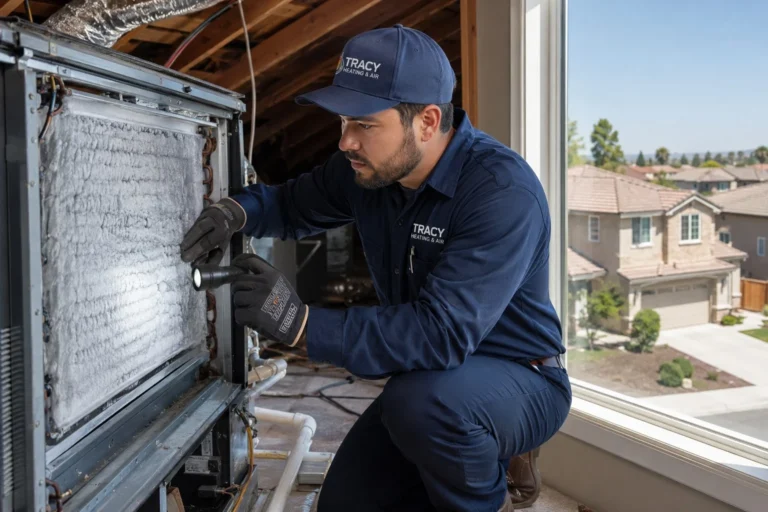
During Tracy’s warm summers, a clogged filter may reduce airflow enough for the evaporator coil to become too cold.
Moisture freezes onto the coil, eventually blocking airflow almost completely.
Instead of cooling your home, your system may blow warm air.
Furnace Overheating
During heating season, restricted airflow can cause excessive temperatures inside the furnace.
Modern systems often shut themselves off as a safety precaution, leading homeowners to believe the furnace is malfunctioning.
Sometimes the solution is simply replacing the filter.
Increased Equipment Wear
When airflow drops, nearly every component works harder.
The blower motor experiences more strain.
The compressor may operate longer.
Fans run for extended periods.
Over months or years, this additional workload can shorten the lifespan of your HVAC system.
Higher Utility Bills
Even if your system continues operating, restricted airflow makes it less efficient.
Many homeowners notice rising energy bills without realizing the filter is the culprit.
Replacing a filter costs only a fraction of what you’ll spend operating an inefficient system.
How Often Should You Replace Your HVAC Air Filter?
One of the most common questions homeowners ask is:
“How often should I replace my HVAC air filter?”
The honest answer depends on several factors.
Most HVAC professionals recommend checking your filter every month and replacing it approximately every 30 to 90 days.
However, your home’s specific conditions matter.
Factors include:
- Number of occupants
- Pets
- Smoking indoors
- Allergies
- Construction nearby
- Wildfire smoke
- Filter thickness
- HVAC usage
- Local air quality
A filter that’s perfectly clean after 60 days in one home could be completely clogged after only 30 days in another.
Replacement Schedule by Household Type
While every home is different, these guidelines work well for most households.
Every 30 Days
Replace monthly if:
- You have multiple pets.
- Someone in the home has allergies or asthma.
- Your HVAC system runs almost constantly during summer.
- Your home experiences significant dust.
- There is nearby construction.
Every 60 Days
A two-month schedule works well if:
- You have one pet.
- Your family spends most days at home.
- Your HVAC system gets moderate use.
Every 90 Days
Three months is often appropriate when:
- No pets live in the home.
- Occupancy is low.
- Indoor air stays relatively clean.
- HVAC use is average.
Even if you follow a schedule, it’s still a good idea to inspect the filter monthly. If it looks dirty, replace it sooner rather than waiting for the calendar.
Signs Your Air Filter Needs Replacing
Your HVAC system often provides clues before serious problems develop.
Watch for these warning signs.
Excess Dust
If you’re dusting furniture more often than usual, your filter may no longer be capturing airborne particles effectively.
Weak Airflow
Reduced airflow from supply vents often indicates airflow restrictions caused by a clogged filter.
Rising Utility Bills
Unexpected increases in energy costs sometimes have surprisingly simple causes, including a dirty filter.
More Allergy Symptoms
Sneezing, itchy eyes, coughing, and congestion may worsen when filters become overloaded with dust and allergens.
Longer Cooling or Heating Cycles
If your air conditioner or furnace seems to run much longer than normal, restricted airflow could be reducing efficiency.
Visible Dirt
Sometimes the simplest test is the best.
Remove the filter.
If it’s coated with gray dust or you can no longer see much light through it, it’s time for a replacement.
Understanding MERV Ratings
Not all HVAC filters are the same.
One of the most important numbers you’ll see is the MERV rating, which stands for Minimum Efficiency Reporting Value.
This rating measures how effectively a filter captures airborne particles.
MERV 1–4
Basic filtration.
These inexpensive filters mainly protect HVAC equipment rather than improve indoor air quality.
MERV 5–8
Suitable for most homes.
They capture common household dust, pollen, lint, and mold spores while maintaining good airflow.
MERV 9–12
Excellent for homeowners with pets or allergy concerns.
These filters trap smaller particles without significantly restricting airflow in systems designed to handle them.
MERV 13+
High-efficiency filtration.
These filters capture extremely small particles but may restrict airflow if your HVAC system isn’t designed for them.
Before switching to a higher-rated filter, consult your HVAC manufacturer’s recommendations or speak with a qualified HVAC professional. Using an overly restrictive filter can reduce airflow and create the very problems you’re trying to avoid.
Final Thoughts
Your HVAC air filter may be one of the least expensive components in your heating and cooling system, but it performs one of the most important jobs.
It protects sensitive equipment, promotes healthy airflow, helps improve indoor air quality, and supports energy-efficient operation. Ignoring it for months at a time can contribute to reduced comfort, higher utility bills, and unnecessary wear on your HVAC system.
For most homeowners, checking the filter once a month and replacing it every 30 to 90 days is a simple habit that pays off in better system performance and long-term reliability.
If you’ve replaced your filter and still notice weak airflow, uneven temperatures, unusual noises, or rising energy bills, it may be time to have your HVAC system professionally inspected to identify any underlying issues before they become costly repairs.