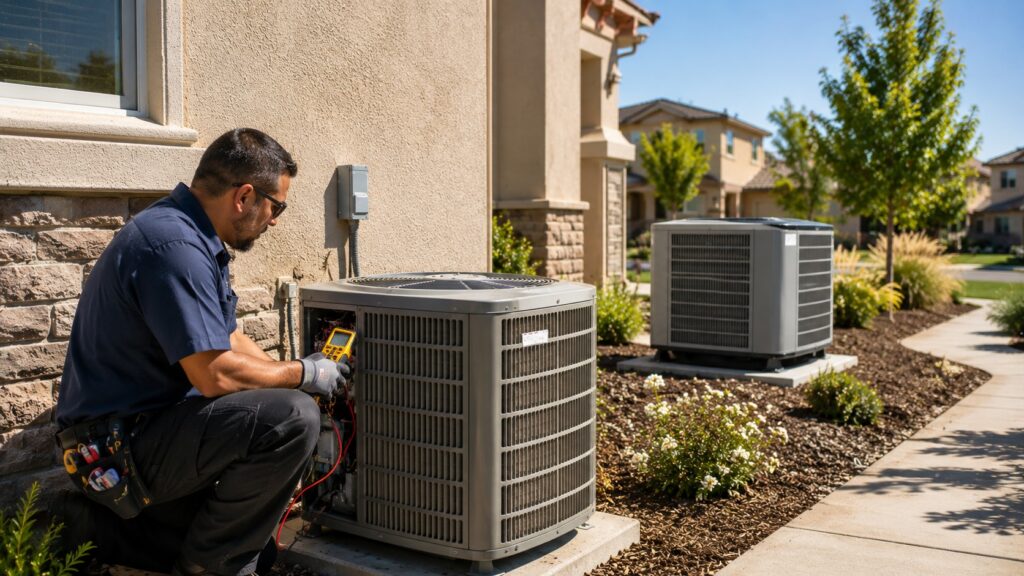
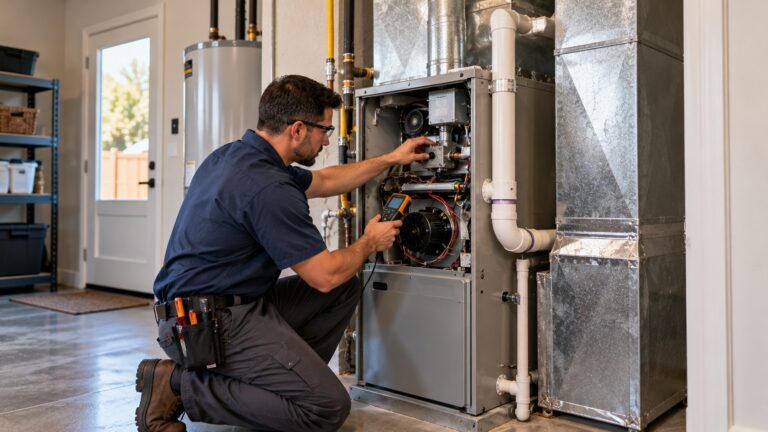
Your air conditioner stops working during a hot Tracy afternoon. An HVAC technician identifies the problem and gives you a repair estimate.
Then comes the question almost every homeowner eventually faces:
Should you repair the air conditioner or replace it?
There isn’t one answer that works for every home.
A relatively young air conditioner with an isolated, affordable problem is often worth repairing. An older system facing an expensive major-component failure, repeated breakdowns, declining efficiency, or ongoing comfort problems may be a better candidate for replacement.
The important point is that AC repair vs replacement should be treated as a financial and performance decision and not simply an age decision.
System age matters. So do repair cost, reliability, energy consumption, refrigerant, maintenance history, comfort, warranty coverage, and the overall condition of the equipment.
For homeowners in Tracy, California, reliability deserves particular attention. Air conditioning isn’t something you use occasionally during summer. When temperatures climb, your cooling system can operate for long stretches day after day.
Before spending significant money on either a repair or a new system, look at the complete picture.
Why the Repair-or-Replace Decision Is Harder Than It Looks
Imagine you own a 12-year-old air conditioner and receive a substantial repair estimate.
Repairing it costs less today than replacing it.
That makes repair seem like the obvious choice.
But what happens if another expensive component fails next summer?
On the other hand, replacing every older air conditioner at the first sign of trouble doesn’t make financial sense either. A well-maintained system could potentially have useful service life remaining.
This is why focusing exclusively on today’s bill can be misleading.
The better question is:
Which option gives you the better combination of cost, reliability, comfort, and expected remaining life?
Think of an older AC like an aging car. Replacing a battery doesn’t mean you need a new vehicle. But if the transmission fails shortly after several other expensive repairs, continuing to invest money deserves more scrutiny.
Your air conditioner works the same way.
One repair is a snapshot. The condition of the entire system tells the story.
Start With the Age of Your Air Conditioner
Age is one of the first factors to consider when comparing AC repair vs replacement.
A newer system experiencing its first repair is in a completely different situation from an aging unit that has operated through many Tracy summers.
As equipment gets older, mechanical wear accumulates. Motors have logged more operating hours. Electrical components have endured repeated cycles. Coils have experienced years of temperature changes and environmental exposure. The compressor has spent thousands of hours circulating refrigerant.
That doesn’t mean an older AC automatically needs replacement.
It means the expected remaining life of the equipment becomes increasingly important when evaluating a large repair.
For example, spending several hundred dollars repairing a younger system that has otherwise performed reliably can be reasonable.
Putting several thousand dollars into a much older system with other deteriorating components requires a different calculation.
Not sure how old your system is? Check the manufacturer’s data plate on the outdoor unit. The serial number or manufacture date can often help determine its age. An HVAC professional can also identify the approximate age.
Compare the Repair Cost With the Value of the System
A common mistake is asking only:
“Can this air conditioner be repaired?”
Many systems technically can.
A better question is:
“Does repairing this particular air conditioner make financial sense?”
Suppose two homeowners each receive a $700 repair estimate.
Homeowner A has a six-year-old system that has been reliable, cools the house evenly, and hasn’t needed significant previous repairs.
Homeowner B has a 14-year-old system that needed another expensive repair last year, struggles during very hot afternoons, and has increasingly high operating costs.
The repair price is identical.
The financial decision isn’t.
For Homeowner A, that $700 could restore a system with years of potential useful service ahead.
For Homeowner B, $700 could become another installment in a growing series of expenses.
That’s why repair price should always be considered alongside system age and overall condition.
What Is the $5,000 Rule for HVAC?
Homeowners researching whether to repair or replace an air conditioner may encounter something called the “$5,000 rule.”
The idea is simple:
Multiply the age of your air conditioner by the estimated repair cost.
For example:
10-year-old AC × $400 repair = $4,000
12-year-old AC × $600 repair = $7,200
Under the traditional guideline, a lower result favors considering repair, while a result above $5,000 points toward taking replacement more seriously.
It’s an appealing rule because it turns a complicated decision into simple arithmetic.
But don’t treat it like a law.
Repair prices, replacement costs, equipment condition, warranties, efficiency, refrigerant, installation quality, and household priorities can vary considerably. A mathematical shortcut cannot inspect your compressor, evaluate your coils, examine electrical components, or tell you how much useful life remains.
Use the $5,000 rule as a conversation starter, not an automatic verdict.
Consider How Often Your AC Has Needed Repairs
Repair frequency is one of the most useful clues homeowners can track.
Every mechanical system eventually needs service. One failed component doesn’t necessarily indicate that the entire air conditioner is deteriorating.
Repeated failures tell a different story.
Look back over the previous few cooling seasons.
Have you called for service once, or does the HVAC technician seem to visit every summer?
Have repairs been small and unrelated, or are significant components beginning to fail?
Are you spending more each year just to keep the system operational?
A pattern of breakdowns matters because today’s repair estimate may not represent the system’s true cost.
Suppose you spend $800 this year, $500 next year, and another $900 the following year. Looking at each bill individually can make each repair appear cheaper than replacement.
Together, however, you’ve spent $2,200 while still owning the same aging equipment.
Keep maintenance records and repair invoices. They give you a much clearer view of what your existing AC is actually costing.
Minor AC Repairs vs Major Component Failures
Not all air conditioner repairs carry the same significance.
An inexpensive failed electrical component on an otherwise healthy system doesn’t necessarily say much about the long-term condition of the AC.
Major component failures deserve closer evaluation.
Smaller Repairs May Favor Keeping the System
Depending on the diagnosis, issues involving items such as certain electrical components, sensors, switches, drain problems, or other replaceable parts may be relatively contained.
If the AC is reasonably young and otherwise performs well, repairing an isolated failure often makes sense.
Major Repairs Change the Calculation
Failures involving components such as the compressor or coils can represent a much larger investment.
When a major repair occurs on older equipment, ask what condition the rest of the system is in.
Replacing one expensive component doesn’t make every other component new.
That’s an important distinction.
A major repair may solve today’s failure perfectly while leaving you with an aging fan motor, electrical system, coils, and other components that have accumulated the same years of use.
Warranty coverage can significantly affect this calculation as well. If an important component is still covered under a manufacturer’s parts warranty, repairing the system may become considerably more attractive.
Always ask exactly what is covered and what isn’t before comparing options.
Think About Energy Efficiency, Not Just Repair Cost
Repair cost is visible.
Operating cost is quieter.
It arrives month after month on your utility bill.
An aging air conditioner may still cool your house but consume considerably more energy than a properly selected modern system.
However, avoid assuming that a new AC will automatically slash your utility bill by a particular percentage. Actual energy use depends on many factors, including:
- Equipment efficiency
- System sizing
- Duct condition
- Insulation
- Air leakage
- Thermostat settings
- Home orientation
- Outdoor temperature
- Maintenance
- Household cooling habits
This matters because replacing inefficient equipment while ignoring major duct leakage or another underlying home-performance problem may not produce the improvement you expected.
If high energy bills are part of your reason for considering replacement, ask the technician to evaluate the whole cooling system, not merely the outdoor unit.
Consider How Well Your AC Cooled Before It Broke
This question is surprisingly powerful:
Were you happy with the air conditioner before it failed?
If the answer is yes, repair becomes more attractive, particularly when the equipment is younger and the repair is reasonable.
If the answer is no, investigate why before spending heavily on it.
Perhaps your upstairs rooms have always been uncomfortable.
Maybe the AC runs constantly on hot afternoons.
Perhaps one side of the house stays warm regardless of the thermostat setting.
Maybe the system short cycles or has never maintained consistent temperatures.
Those symptoms can result from equipment problems, airflow restrictions, duct issues, incorrect sizing, insulation deficiencies, or other causes.
Replacing the outdoor equipment without diagnosing the actual comfort problem isn’t necessarily a solution.
The goal isn’t merely to own a newer air conditioner.
The goal is to have a properly designed cooling system that keeps your home comfortable efficiently and reliably.
Refrigerant Type Can Affect the Decision
Refrigerant deserves consideration when evaluating an older air conditioner, particularly when a refrigerant-related repair is involved.
Older equipment may use refrigerants that have been phased out or are becoming increasingly impractical to service. Meanwhile, the HVAC industry continues transitioning to newer refrigerant technologies and equipment standards.
This doesn’t mean refrigerant type alone determines whether you should replace an AC.
It does mean you should know what your existing system uses before authorizing a major refrigerant-related repair.
Ask your HVAC technician:
What refrigerant does my system use?
Is it readily serviceable?
Is the leak repairable?
Where is the leak?
What would the complete repair involve?
Does the age and condition of the equipment justify that expense?
A refrigerant leak is not solved simply by repeatedly adding refrigerant. If refrigerant is escaping, the underlying problem should be properly diagnosed.
How Tracy’s Summer Heat Changes the Equation
Location matters when deciding whether to repair or replace an air conditioner.
Tracy homeowners know that summer cooling isn’t theoretical.
Extended periods of high temperatures can place substantial demand on residential cooling equipment. An AC that appears “good enough” during mild weather may reveal its weaknesses when outdoor temperatures rise and the system has to operate for long periods.
That makes reliability valuable.
If an older system has become increasingly unpredictable, consider the practical cost of another breakdown and not just the mechanical repair cost.
An AC failure during moderate spring weather is inconvenient.
An AC failure during an intense summer heat wave can become much more disruptive.
Demand for HVAC service can also rise during periods of extreme heat because many systems across the area are operating under heavy loads simultaneously.
This doesn’t mean Tracy homeowners should prematurely replace working air conditioners.
It means reliability should carry meaningful weight in the repair-versus-replacement equation, particularly when an aging system already has a pattern of significant failures.
Don’t Ignore Your AC’s Maintenance History
Two air conditioners of exactly the same age can be in very different condition.
One may have received routine professional maintenance, regular filter changes, prompt repairs, and good airflow throughout its life.
Another may have operated for years with clogged filters, neglected coils, restricted airflow, or unresolved mechanical problems.
Age alone won’t reveal that difference.
Maintenance history helps provide context.
A well-maintained older system with one isolated problem may still be a reasonable repair candidate.
An equally old system showing widespread wear after years of neglected maintenance could be a much weaker investment.
This is another reason online calculators can only take you so far.
They know the number of years.
They don’t know the condition of your equipment.
When Repairing Your Air Conditioner Usually Makes Sense
Repair may be the more practical option when several of these conditions apply:
The system is relatively young.
A newer AC generally has more potential service life remaining, assuming the rest of the equipment is healthy.
The repair is isolated and affordable.
A small component failure doesn’t automatically justify replacing thousands of dollars of equipment.
The system has been reliable.
One breakdown after years of dependable operation is different from repeated failures.
Comfort was good before the breakdown.
If your AC maintained comfortable temperatures and reasonable energy consumption before one component failed, restoring it may be sensible.
Important components are still under warranty.
Warranty coverage can substantially change repair economics.
The overall equipment condition is good.
A technician’s inspection doesn’t reveal broader deterioration or multiple components approaching failure.
Repairing a system under these circumstances isn’t “putting money into an old AC.”
It can simply be responsible equipment ownership.
When Replacing Your Air Conditioner May Make More Sense
Replacement deserves serious consideration when multiple warning signs begin stacking up.
The AC Is Approaching the End of Its Practical Life
Age doesn’t automatically condemn equipment, but expensive repairs become harder to justify as expected remaining life decreases.
Repairs Are Becoming Frequent
Repeated service calls can turn an apparently economical old system into an expensive one.
You’re Facing a Major Repair
A large compressor, coil, or similarly substantial repair on aging equipment warrants a full replacement comparison before you authorize the work.
The System Has Persistent Comfort Problems
If your AC has struggled for years, even when technically operating, repairing one failed component won’t necessarily address the underlying performance problem.
Energy Consumption Has Become a Concern
A significant difference in efficiency may make replacement worth evaluating, particularly when combined with age and expensive repairs.
Multiple Problems Exist at Once
An AC with one failed component may be repairable.
An AC with one failed component plus deteriorated coils, aging electrical parts, airflow problems, and a history of breakdowns presents a different picture.
The key word is pattern.
Replacement becomes easier to justify when several independent factors point in the same direction.
Final Thoughts: Make the Decision Based on the Whole System
When deciding between AC repair vs replacement, avoid looking for one magic number.
Your system’s age matters.
So does the repair price.
But neither tells the complete story.
Look at how reliably the system has operated, how comfortable your home has been, whether energy consumption has changed, what components are failing, whether warranties remain, what refrigerant the system uses, and what condition the rest of the equipment is in.
A relatively young, reliable air conditioner with an isolated problem may have many useful years remaining after a professional repair.
An aging system with recurring breakdowns, poor comfort, major component problems, and mounting repair costs may be telling you something different.
For Tracy homeowners, the goal isn’t simply to choose whichever option costs less today.
It’s to determine which investment gives your household the strongest combination of comfort, reliability, efficiency, and long-term value through the hot summers ahead.
A thorough professional diagnosis gives you the information needed to make that choice based on your actual equipment rather than a generic formula.