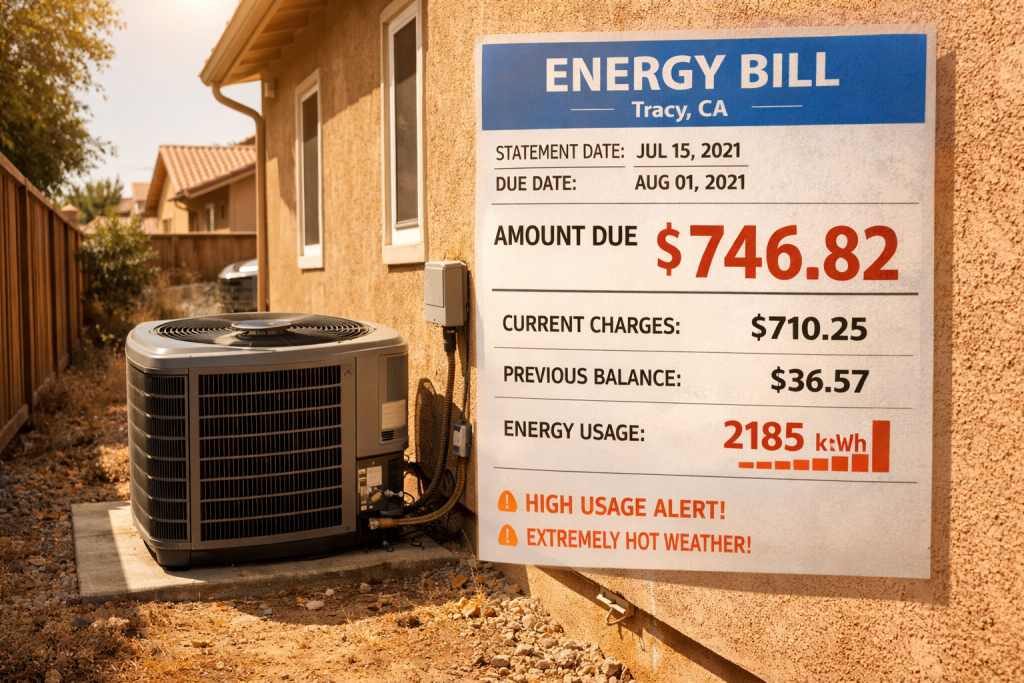
You open your utility bill. Your eyes widen.
How did it jump this high?
If you live in Tracy, California, you’re not alone. Summer temperatures regularly climb into the 90s and triple digits. Your air conditioner works hard, sometimes nonstop, to keep your home comfortable.
But here’s the truth most homeowners don’t realize:
Extreme heat isn’t always the main reason your bill skyrockets.
In many cases, hidden HVAC efficiency problems are quietly draining your wallet month after month.
At AC Heating & Cooling Services, we’ve seen it repeatedly: homeowners assume high energy bills are “just part of summer,” when in reality, their HVAC system is operating at 60–70% efficiency or worse.
Let’s break down why this happens and what it means for your home.
Why Tracy Homes See Higher Cooling Costs
Tracy sits in California’s Central Valley, where summers are dry, hot, and long. Unlike coastal climates that cool off in the evenings, Tracy often holds heat well into the night.
That means:
- Longer AC run times
- Higher compressor workload
- Increased duct temperature stress
- More strain on aging systems
If your HVAC system is even slightly inefficient, Tracy’s climate amplifies the problem.
Think of it like driving a car uphill. A small engine issue might not show on flat roads. But on a steep incline? It becomes obvious fast.
Summer in Tracy is that incline.
The Hidden Role Your HVAC System Plays
Your HVAC system accounts for nearly half of your home’s total energy use during peak cooling season.
So when your energy bill jumps $100–$300, your HVAC system is often the primary culprit.
But here’s the tricky part:
An inefficient system can still cool your home.
It may just take longer.
It may run constantly.
It may struggle during peak heat.
It may cycle more often than it should.
You might not notice performance problems, but your utility company does.
10 HVAC Efficiency Problems That Drive Up Energy Bills
1. Dirty Air Filters
A clogged air filter restricts airflow.
When airflow drops:
- The system runs longer
- The blower motor works harder
- Energy consumption increases
In Tracy’s dusty summer climate, filters clog faster than homeowners expect.
A $20 filter can quietly cost you hundreds in wasted electricity if ignored.
2. Low Refrigerant Levels
If your AC is low on refrigerant due to a leak, it cannot absorb heat efficiently.
Symptoms may include:
- AC running constantly
- Longer cooling cycles
- Warm air from vents
- Higher energy bills
The system compensates by running longer, which increases electricity use dramatically.
3. Leaky Ductwork
This is one of the most overlooked HVAC efficiency problems in Tracy homes.
Duct leaks can waste 20–30% of conditioned air before it ever reaches your rooms.
That means your system is cooling the attic, walls, or crawlspace instead of your living space.
The AC runs longer to compensate.
Your bill climbs.
You feel frustrated.
4. Aging Air Conditioning Units
Even if your AC still works, age matters.
After 10–15 years:
- Efficiency drops significantly
- Parts wear down
- Compressor performance declines
Older systems may operate at SEER ratings far below today’s efficiency standards.
That difference shows up clearly on your monthly bill.
5. Incorrect System Size
Bigger is not always better.
An oversized system:
- Short cycles frequently
- Fails to dehumidify properly
- Wastes energy on repeated startups
An undersized system:
- Runs constantly
- Struggles during peak heat
- Consumes excess electricity
Proper load calculation is essential for energy efficiency.
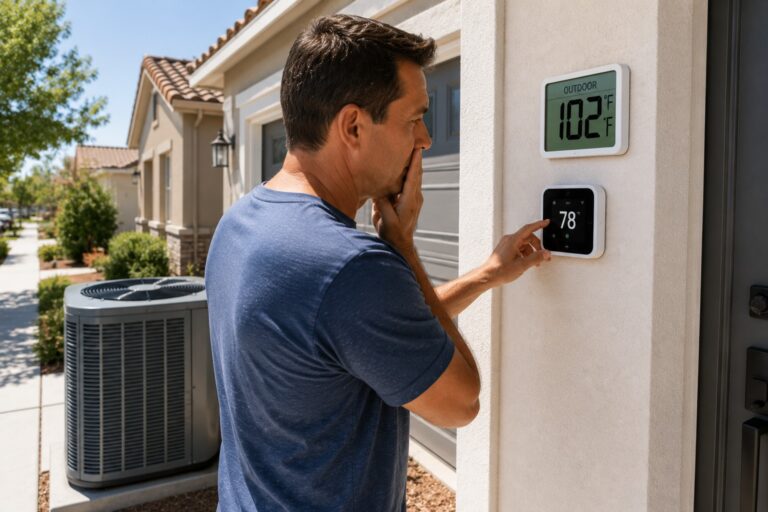
6. Poor Thermostat Calibration
Sometimes the issue isn’t the AC, it’s the control system.
If your thermostat:
- Is miscalibrated
- Sits in direct sunlight
- Is near heat-producing appliances
It may read the temperature incorrectly.
Your system runs longer than necessary.
Smart thermostats can help, but only when installed and configured properly.
7. Lack of Routine Maintenance
HVAC systems are mechanical machines.
Without annual tune-ups:
- Coils get dirty
- Electrical connections loosen
- Refrigerant pressures drift
- Motors wear down
Each small issue chips away at efficiency.
By the time you notice your energy bill spike, the inefficiency has already been building for months.
8. Failing Capacitors or Motors
Your AC relies on capacitors and motors to start and maintain operation.
When these components weaken:
- Startup becomes harder
- Energy draw increases
- The compressor strains
This is often invisible to homeowners but highly visible on energy consumption reports.
9. Poor Insulation Interaction
Your HVAC system and home insulation work together.
If your attic insulation is insufficient or compromised:
- Heat enters your home faster
- Cooling demand increases
- AC run times extend
Even a perfectly working AC will struggle if the home envelope is inefficient.
10. Constant Cycling
Does your system turn on and off frequently?
Frequent cycling:
- Uses more energy during startup
- Increases wear and tear
- Reduces overall efficiency
This can result from thermostat issues, oversizing, airflow problems, or electrical faults.
It’s like repeatedly slamming the gas pedal in traffic instead of cruising steadily.
Why “Running Fine” Doesn’t Mean “Running Efficiently”
Here’s one of the biggest misconceptions homeowners have:
“If it’s cooling the house, it must be fine.”
Not necessarily.
An HVAC system can maintain temperature while operating inefficiently.
It may:
- Run 20–40% longer than necessary
- Use significantly more electricity
- Strain internal components
You won’t always notice discomfort.
But your bill will tell the story.
Efficiency is about performance per energy unit, not just whether cool air comes out of the vents.
The Real Cost of Ignoring HVAC Inefficiency
High energy bills aren’t the only consequence.
When your HVAC system runs inefficiently:
- Components wear out faster
- Repair frequency increases
- System lifespan shortens
- Emergency breakdown risk rises during peak heat
In Tracy’s summer climate, breakdowns often happen during the hottest weeks, when your system is already under maximum stress.
Efficiency problems today can become emergency repairs tomorrow.
When to Schedule a Professional HVAC Evaluation
You should consider a professional inspection if:
- Your energy bill has increased unexpectedly
- Your AC runs constantly
- Some rooms feel warmer than others
- Your system is over 8–10 years old
- You haven’t had annual maintenance
A proper HVAC evaluation includes:
- Refrigerant pressure checks
- Airflow testing
- Duct leakage inspection
- Electrical performance testing
- Coil condition assessment
- Thermostat calibration
These diagnostics uncover hidden efficiency losses you cannot see.
Preventing High Energy Bills in Tracy’s Climate
Here’s how Tracy homeowners can reduce cooling costs long-term:
Replace Filters Regularly
Check monthly during peak season.
Schedule Annual Maintenance
Spring tune-ups prepare your system for extreme summer heat.
Seal Ductwork
Address leaks to prevent wasted conditioned air.
Upgrade Aging Systems
Modern high-efficiency units dramatically reduce energy use.
Install Smart Thermostats
Improve temperature management and reduce unnecessary run time.
Improve Insulation
Attic upgrades can significantly lower cooling demand.
When these elements work together, your HVAC system operates smoothly, like a well-tuned engine instead of a strained one.
How PG&E Rate Structures Impact Your Cooling Costs in Tracy
If you live in Tracy, your high summer energy bills aren’t just about how long your AC runs, they’re also about when it runs.
Most homeowners in the area are on time-of-use (TOU) electricity plans. That means energy costs more during peak demand hours, typically late afternoon and early evening. Unfortunately, those peak hours often overlap with the hottest part of the day.
Here’s where HVAC efficiency becomes even more critical.
If your system is inefficient and runs longer than necessary between 4 PM and 9 PM, you’re not just using more electricity, you’re using more expensive electricity.
An inefficient HVAC system during peak hours can:
- Multiply cooling costs dramatically
- Increase strain on the compressor
- Extend run times into higher rate windows
- Prevent pre-cooling strategies from working effectively
For example, a properly tuned system might cool your home efficiently before peak pricing begins, then cycle minimally during high-rate hours. But an inefficient unit will struggle to maintain temperature and run continuously, right when electricity costs the most.
This is why HVAC performance and energy billing are directly connected in Tracy.
When homeowners say, “My bill doubled this month,” the issue is often a combination of:
- Increased cooling demand
- Peak-rate electricity pricing
- Reduced HVAC efficiency
Understanding this relationship is key. You’re not just fighting heat, you’re fighting timing and system performance.
Improving HVAC efficiency doesn’t just reduce energy usage. It reduces high-cost energy usage.
Should You Repair or Replace an Inefficient HVAC System?
If your energy bills keep climbing, you may be asking a bigger question:
Is it time to replace my system?
This decision isn’t always straightforward. Many homeowners assume that if their AC is still working, replacement isn’t necessary. But “working” and “working efficiently” are two very different things.
Here are some guidelines Tracy homeowners should consider:
Repair May Make Sense If:
- Your system is under 10 years old
- The issue is isolated (capacitor, refrigerant leak, airflow restriction)
- Repair costs are relatively minor
- The system was properly sized at installation
Replacement May Be the Smarter Investment If:
- Your unit is 12–15+ years old
- SEER rating is significantly below modern standards
- Repairs are becoming frequent
- Energy bills continue rising despite maintenance
- The system struggles during extreme heat
Modern high-efficiency HVAC systems can dramatically reduce electricity consumption, especially in hot Central Valley climates like Tracy. Higher SEER ratings, variable-speed compressors, and advanced airflow design allow systems to cool homes more evenly and use less power.
Think of it like upgrading from an old refrigerator to a new ENERGY STAR® model. Both keep food cold. But one does it with far less electricity.
In many cases, homeowners find that the energy savings from a new system offset the investment over time, particularly when summer temperatures remain consistently high.
If you’re unsure, a professional efficiency evaluation can provide clear performance data and help you make an informed decision based on numbers and not guesswork.
Final Thoughts
If you’ve been wondering:
“Why is my energy bill so high?”
The answer is often closer than you think.
Your HVAC system may be working harder than necessary, not because it’s broken, but because it’s inefficient.
In Tracy’s hot climate, small efficiency problems become expensive quickly.
The good news?
Most HVAC inefficiency issues are diagnosable and correctable.
Understanding what drives high energy bills is the first step toward lowering them and protecting your home comfort long-term.